Turning personality tests into action with a Notion system
Personality tests are where progress goes to die.
Not because the tests are useless, but because the output usually goes into a PDF, gets emailed around, and then disappears into a folder nobody opens again.
I’m building a Notion system for a business coaching company here in New Zealand that fixes that exact problem. The goal is simple. Capture the insights once, store them properly, and turn them into something people can use immediately.
If you’re looking for Notion consulting, this is the kind of work I do. I build systems that take messy information and turn it into clear action, without adding admin.
The real problem with assessments
Working Genius, 16 Personalities, CliftonStrengths. These frameworks can be incredibly useful, but only if they change what happens next.
Most organisations get stuck in “awareness mode”.
They gather information about someone’s style, strengths, and tendencies, but they don’t convert it into a plan. Managers don’t know what to do with it. The individual doesn’t know what to do with it. The coach ends up spending valuable session time summarising what the test already said.
That’s the gap. Notion is a great place to close it because it can hold structured data, connect it to workflows, and keep everything easy to access when it matters.
The system flow inside Notion
Here’s the flow I’m building.
A client fills in a few forms to capture their results and context. This might include their Working Genius, their 16 Personalities type, their CliftonStrengths, plus some practical prompts about goals, energy, communication preferences, and what they’re struggling with right now.
That information lands inside Notion, structured into databases rather than scattered across pages. This is the part most DIY setups miss. If the data model is messy, the rest of the system becomes a house of cards.
Once the inputs are structured properly, you can generate reporting that’s actually useful for an individual and their team.
Not in a vague “here are your strengths” way.
In a practical “here’s how we work with you” way.
Two reports that actually get used
The system produces two clear outputs based on the person’s profile.
The first is a report for the individual. This focuses on how they operate at their best, what drains them, what conditions help them perform, and what kinds of actions they’re most likely to follow through on. It turns the assessment results into something grounded and usable, with a short plan that fits how they work.
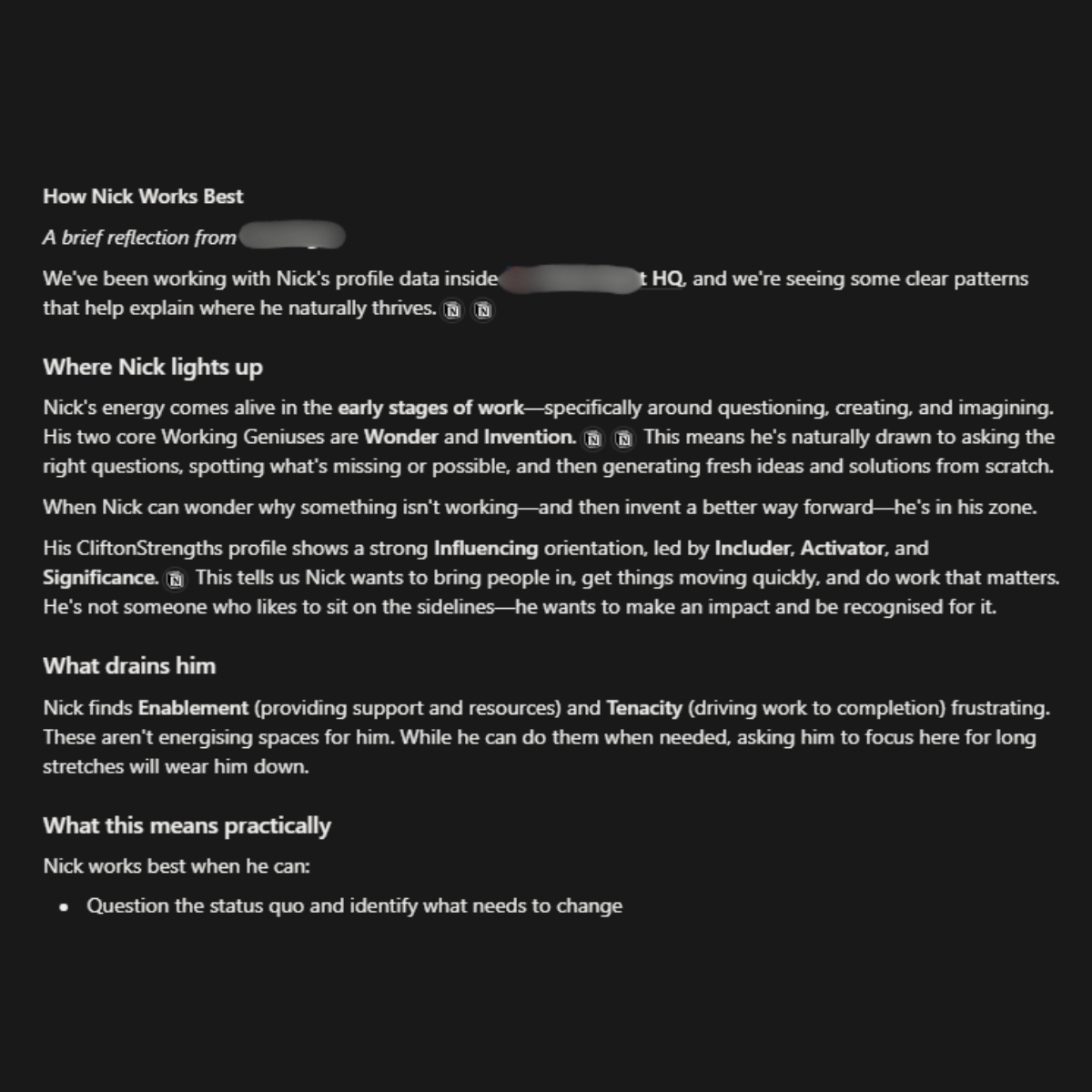
The second is a report for their manager. This is where the leverage is. Managers don’t need another personality label. They need a guide for communication and leadership.
How to communicate with this person so it lands.
How to structure tasks so they perform.
How to give feedback without triggering shutdown or disengagement.
What to avoid when the person is under pressure.
When you give a manager that level of clarity, the working relationship improves fast. Fewer misunderstandings. Less frustration. More momentum.
Why this matters for coaching and leadership
A coach still needs to be in the room.
This doesn’t replace the human conversation, and it shouldn’t. The value of coaching is judgment, nuance, accountability, and the ability to read what’s unsaid.
What the system does is remove the slow prep work.
Instead of spending the first chunk of a session figuring out what makes someone tick, the coach can start with clarity. The coach can spend time on the person, not on retyping summaries and translating assessment language into something practical.
It also creates consistency. Every client gets a structured experience. Every manager gets clear guidance. The output isn’t dependent on who had time that day to write a decent summary.
Why Notion is the right tool for this
Notion works for this because it can act as the single source of truth.
Forms capture the inputs.
Databases store the profile information in a structured way.
Views and dashboards let coaches and managers see exactly what they need without digging.
And Notion AI can help generate first draft reporting from the client’s own context, which can then be reviewed and refined by the coach.
The key is designing the system properly. If you don’t get the data structure right, you end up with a pretty dashboard that still doesn’t drive action.
This is why Notion consulting matters. The value isn’t in the tool. It’s in the design of the system and the workflow around it.
What this means for businesses using Notion
If you’re running a coaching company, leading a team, or managing clients, there’s a bigger lesson here.
Data collection is not the goal.
Action is the goal.
A good Notion system doesn’t just store information. It turns information into decisions, next steps, and clear communication.
That’s the difference between a Notion workspace that looks impressive and one that actually changes how the business operates day to day.
Need a Notion consultant?
If you’re using Notion and it still feels messy, you’re not alone. Most setups fall apart because they were built page first, not database first, or they weren’t designed around a real workflow.
I build custom Notion systems for service businesses, teams, and consultants who want clarity, consistency, and less admin. If you want help building a Notion workspace that actually drives action, get in touch through my contact page and tell me what’s currently breaking in your workflow.